This interview was originally written in Dutch and published in the magazine of the Flemish Gliding Federation.
The English version below is a faithful translation of the original text, with the original wording and intent preserved as closely as possible.
Interview with Jeroen Jennen, World Champion in Gliding
At the beginning of June, the World Gliding Championships kicked off in Tábor, Czech Republic. Belgium was once again strongly represented, with pilots competing in the Club Class, Standard Class, and 15-Metre Class.
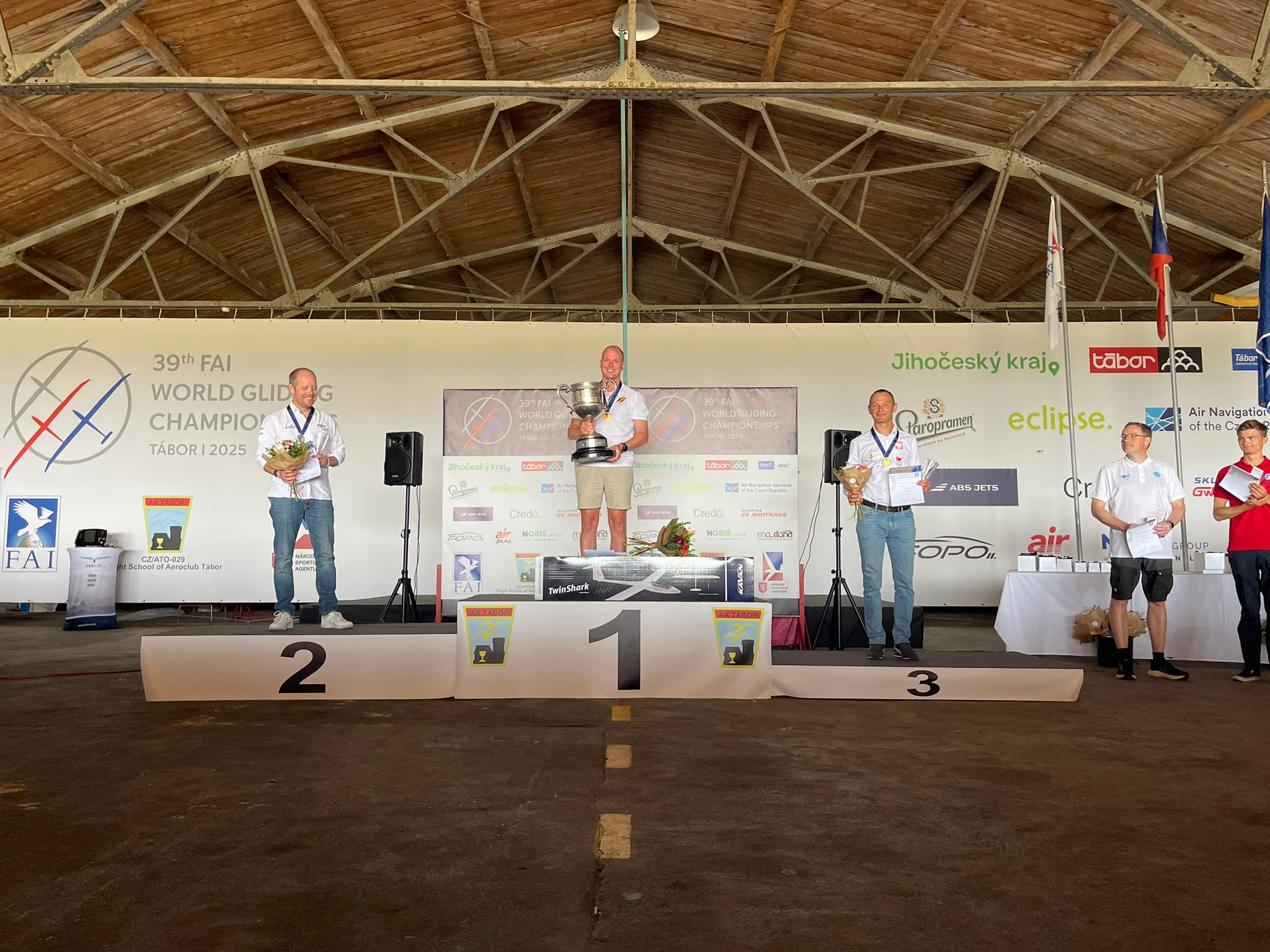
After ten official competition days in highly varied weather conditions, fantastic news reached Belgium on June 20th: once again, we could welcome a world champion among us.
With a lead of more than 500 points, Jeroen Jennen crowned himself World Champion in the Standard Class. He promised to provide an extensive report later this winter, but during the Belgian National Championships I already had the chance to speak with him.
Can you tell us how you got started in gliding?
That actually started very early on. As a little kid, I often flew along at Keiheuvel, because my parents were running the tavern there — De Kei — at the time.
Up until I was sixteen, I never had formal lessons, but I did fly along regularly. When I turned sixteen, I started taking lessons properly. After the Easter camp, I flew solo already — after about thirteen training launches, I think. That’s how it all started, mainly thanks to flying along so much with Eddy (Huybreckx) and my uncle Rik.
Last year you were also in Tábor, Czech Republic. Was that part of your preparation for the World Championships?
The original goal was actually the 2021 World Championships, together with Dennis. Dennis later moved to the 18-Metre Class, and I then flew in Tábor with Jef (Kell).
This year, 2025, was the real main objective. The preparation in Tábor last year helped me enormously. It was especially useful to learn the local weather patterns and to get used to the typical blue thermals there.
In Belgium, we often fly towards cities, whereas there it was mainly forested areas. In those forests, there were open patches — where trees had been cut down — with heathland in between, and those spots turned out to be excellent thermal triggers. I learned that last year, so this year I could immediately apply that knowledge. That definitely gave me confidence.
Did you take any other special preparations before leaving?
Actually, I flew very little this year. I only had two launches before the World Championships, because I had surgery in April and couldn’t fly for a while.
What I did do, however, was fly a huge amount on Condor this winter. And I’m truly convinced that makes a difference, especially for the tactical aspects of competition flying.
In addition, I reviewed my flights from last year and analysed my mistakes. I tried to correct those — and apparently that worked out quite well (laughs).
Which competition day did you find the most exciting?
The second-to-last day, without a doubt. That was when I was the most nervous. Before that, it was actually manageable — I didn’t notice it too much, except that I slept less well.
That day started off difficult right away: shortly after the tow, I had a low point close to the airfield. I hesitated for a moment about landing back, but I kept searching and managed to climb again — just in time for the start. No one had left yet.
I crossed the start line without knowing whether anyone had already gone before me. I thought there might have been a Romanian pilot already on task, and I was hoping others had gone too. Eventually, it turned out that my biggest competitor had indeed started before me. I encountered him after the first turning point.
The first part of the flight went well, so the stress eased a bit. Until I reached the hills. There, I really only had one option — and it didn’t work straight away. So I flew back on track, crosswind, hoping to find a thermal. What I found wasn’t great. And that’s when the nerves really kicked in, because I knew the Polish pilots had already flown further ahead and had made the connection.
Then suddenly a whole group joined me — pilots who had started about ten minutes after me. From that moment on, my head calmed down a bit. I thought: Even if I lose 150 points here, I’ll still have 50 left for the final day.
In the end, we managed to catch up with that first group almost entirely. And towards the end, we even arrived together, because the weather deteriorated with a lot of headwind. The climb rates were only around 0.8 to 1 m/s — so it became exciting just to make it back home at all.
When I finished, I knew: this is good. And in hindsight, the stress may have been unnecessary. Because of that, I had no nerves at all on the final day. I had a 300-point lead — I just needed to fly safely.
After the start on the last day, I saw on the LX that the pilots behind me had started four to five minutes later. On a three-hour AAT, that’s not much, so I didn’t mind them catching up. The first part was blue anyway, so I didn’t want to fly alone.
In the sector, cumulus clouds appeared, but they chose a different route than I did. Eventually, I exited the sector together with Robbie (Seton), back in blue conditions. We flew that part together. The rest flew further north — which eventually turned out not to be the best choice.
So I even won the final day as well!
Did you have to deal with any technical issues during the competition?
Yes, once. The water system in the left wing had broken, so I couldn’t fill water. That caused a brief moment of panic at the start, because I didn’t know whether it could be fixed in time. A fairly high cloud base was forecast, so I could really have used the water.
With help from Wim over the phone and my four retrieve crew members, we managed to fix it quickly. Luckily, I was positioned at the back of the grid and we departed late, so we had time.
If it hadn’t worked out, it wouldn’t have been a disaster either — then I would have flown only with the outer tanks and fixed it in the evening. Which we did anyway. Everything was neatly finished in the hangar, without rush. That kept the stress fairly limited.
Do you have a secret weapon?
(laughs) Well, I don’t really have any true secrets. Condor has helped me a lot. And in the beginning, I learned an enormous amount from Eddy, who always gave me great advice.
Flying together with Dennis was probably the most important part of my learning process. All the experience we gathered together, and the tips he kept giving me, made me a better competition pilot.
All of that — combined with continuously refining my own experience — is what made it work this year.
It’s also going well now at the Belgian Nationals, even with a different glider. But on the Lima Tango, I’ve flown around 1,500 hours by now. I know exactly what that aircraft wants: whether I should turn, fly straight… Even before the variometer moves, I already feel that I need to turn.
By the way, I never fly full water. I always stay below 500 kg. Many fly heavier, but this works better for me.
Would you like to add something to conclude?
Yes — simply a big thank you to everyone. From Amber, to my four retrieve crew members — especially Patrick, who has been coming along since the very beginning — to Dennis, Eddy for all the help, Jef for the glider, and Wim, who always helps me with technical matters.
A lot of people for one champion?
Absolutely. You always need help. And that makes it lighter for me as well. On the ground, I only have to focus on the glider. Going to the shop, cooking food — everything is taken care of. That really helps.
One thing the pilot does have to do is the dishes. (laughs)
Thank you for the interview — and once again, congratulations!
Thank you! My pleasure.