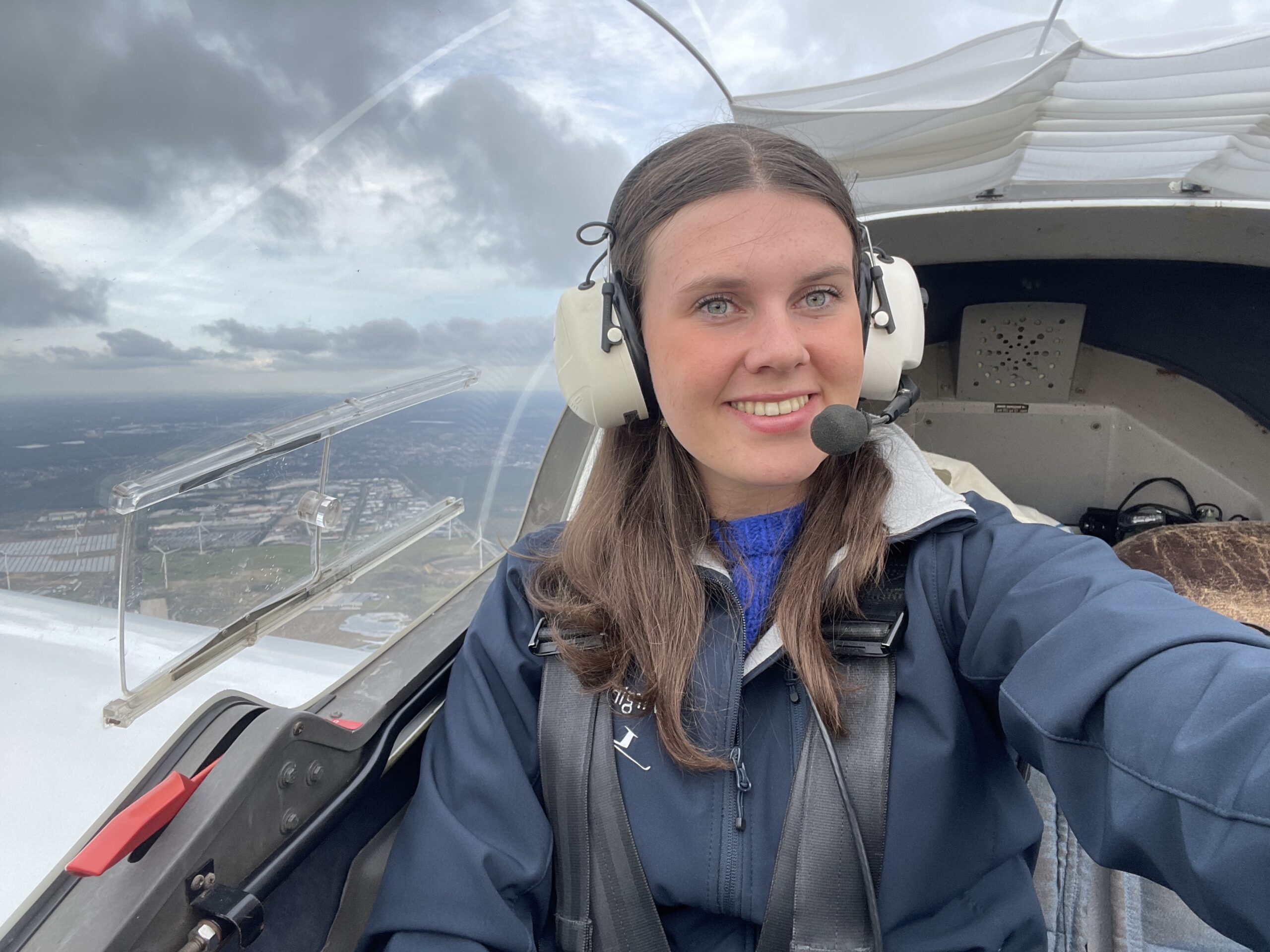
Finally, after almost a year, I was able to fly again in our club’s motorglider, a HK36 Super Dimona. A motorglider is a type of aircraft one can fly with an extension on a glider pilot’s license or SPL. Even though it is sometimes confused with a glider with an auxiliary engine, it is not the same. It is better compared to a ULM (ultra-light aircraft), but with longer wings.
The aircraft I fly, the Super Dimona, is made by Diamond Aircraft Industries, and might remind you of the DA20, the smaller version of the now very popular DA40, often used for PPL(A) flight training. However, the Dimona flies slower, is lighter, has longer wings, and can therefore be flown with an SPL.
In 2022, I obtained my SPL in April, and toward the end of that gliding season (around October/November), I decided to spend the winter learning how to fly the motorglider. Winter, with its lack of thermals, isn’t ideal for long gliding flights, but it’s perfect for motorgliders since they offer more possibilities to fly, even on cold, calm days.
I must admit, in the summer, I prefer pure gliding. There’s an unmatched sense of freedom with no engine noise and the challenge of keeping your flight going by reading the weather and the terrain. But winter is long, and motorgliding fills that gap.
My plan was simple: make a few flights with an instructor and get the TMG (Touring Motor Glider) extension added to my license. But things didn’t go as smoothly as I’d hoped. After just one short flight, the aircraft had to be grounded due to a propeller issue that was discovered during other flights when oil started leaking over the canopy. While I wasn’t involved in the incident, it unfortunately meant that the aircraft needed repairs, which ended up taking the entire off-season.
By May, our Dimona was back in action, so I made another flight, then two more in June, each between 30 and 45 minutes long. During those flights, I was able to practice emergency procedures like engine-out landings. But as the gliding season kicked off again, I shifted focus back to cross-country gliding to build experience.
When the 2023 gliding season ended, I got back to the motorglider with another flight alongside my instructor. Thankfully, I hadn’t lost my touch, and I was able to make my first solo flight! (Yay!) It was a huge milestone, and I was thrilled to finally achieve it.
However, as luck would have it, more delays followed. Belgium saw a lot of rain, and even when it wasn’t raining, the airfield was often waterlogged, forcing it to close. That made for a winter with very few flying opportunities, and once again, I had to put flying on hold.
By summer, my attention was back on gliding. I flew in my first larger competition, the Belgian Nationals. Once the competition was over, I was eager to return to the motorglider, but—surprise!—more technical issues cropped up after someone made a bad landing, and the aircraft was out of service again.
Finally, last week, the Dimona was back and ready to fly. I wasted no time and reserved a slot on the very first available day. The weather was perfect, and after two touch-and-go landings, my instructor told me to make a full stop, and I was once again flying solo.
I had an amazing flight, completing two touch-and-gos and taking a little tour around the area, logging another 30 minutes of solo time. I couldn’t have been happier with how it all turned out—and I even recorded the whole thing on video! It was almost a year since my first short solo flight, so I humorously named the YouTube video “My Second ‘First’ Solo.” (Here’s the link if you’d like to watch: https://youtu.be/xSmv23j5GSA?si=srEd9MqR6drybTHY.)
This Saturday, I did a navigation flight to a nearby airfield with my instructor, preparing for my solo navigation flight, which I hope to complete next week if the weather cooperates!